AI Search Demand Generation Statistics: UK 2026


Send to your email
Enter your email below and a link to download the PDF of this article will be sent directly to your inbox.

AI search is rapidly changing how B2B buyers find information, evaluate brands, and move through the buying journey. For B2B marketing revenue leaders, this creates new opportunities to make their brand visible to potential customers, while also raising questions about which platforms, strategies, and measurement methods are most effective.
To find out what 130,452 opinions of B2B marketing revenue leaders in the UK were about AI search demand generation, we utilised AI-driven audience profiling to synthesise insights from online discussions over 12 full months ending September 23rd, 2026, to a high statistical confidence level. The resulting statistics provide insight into how businesses are adapting their demand generation strategies as AI search becomes a more established part of the B2B buying journey.
Index
- Methodology and data
- At 54% of B2B marketing revenue leaders’ organisations, the SEO or content team is definitely responsible for AI search demand generation; 36% agree these teams are likely to take responsibility, but 5% say it’s not really their job, and 3% agree it’s not their responsibility at all, while at 1% of leaders' organisations, the marketing or demand generation team owns AI search demand generation, and 2% have not yet assigned clear ownership
- 65% of B2B marketing revenue leaders agree that their SEO or content team is likely the leader of their AI search demand generation efforts, and 35% cite an agency partner as their leader
- While 71% of B2B marketing revenue leaders are not currently using AI in demand generation, 14% are using it for personalisation and targeting, and another 14% are using AI for search and demand generation
- 97% of B2B marketing revenue leaders confirm that their buyers discover their brand via voice assistants, and 3% are discovered by direct AI chat queries
- For 20% of B2B marketing revenue leaders, ChatGPT or OpenAI search is essential to their demand generation strategy, and it’s a valuable addition for 46%, but not a priority for 9%, and it doesn't matter for 6%; for 7% Google AI overviews or Gemini are essential to their demand generation strategy, and 5% agree they're a valuable addition, but they are not a priority for 1%, while 3% name Perplexity as essential, and 3% view it as a valuable addition
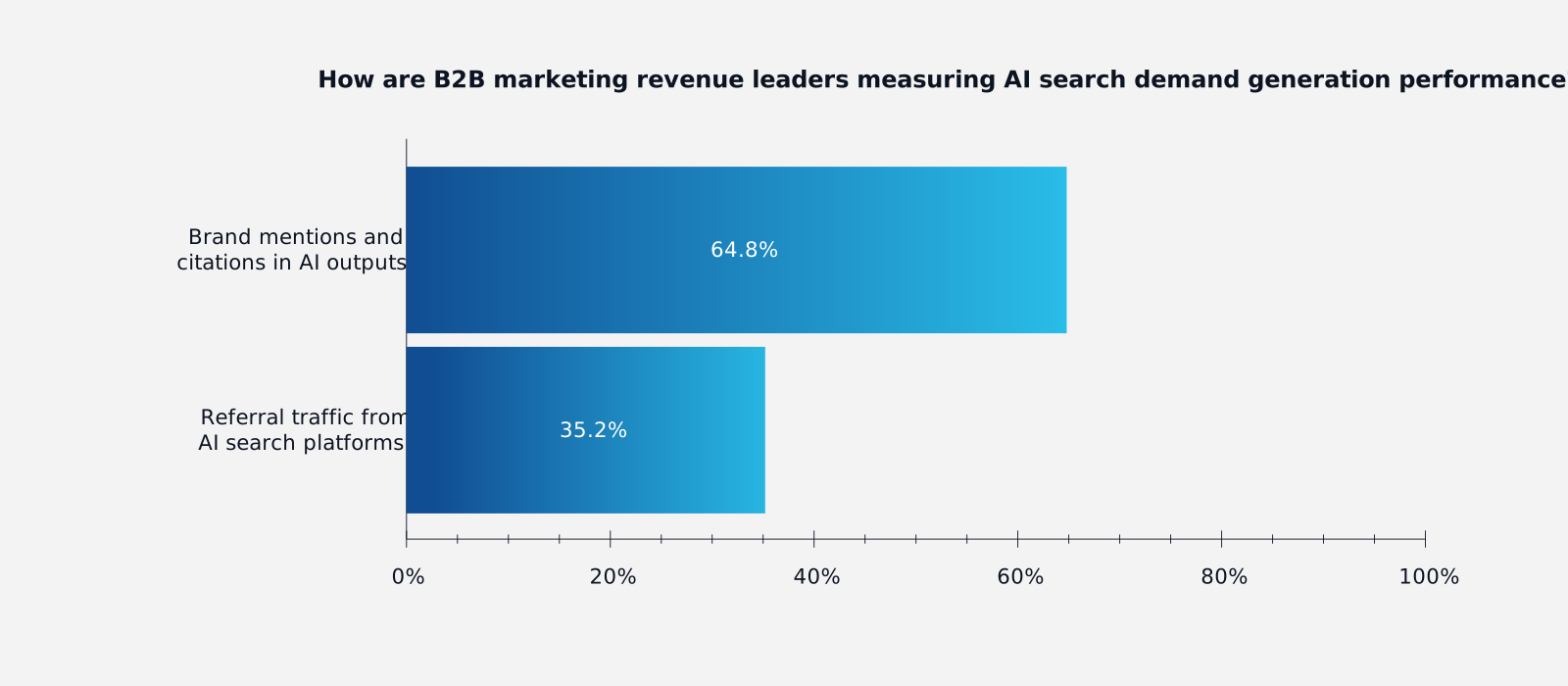
- 65% of B2B marketing revenue leaders are measuring AI search demand generation performance by brand mentions and citations in AI outputs, and 35% are measuring it in referral traffic from AI search platforms
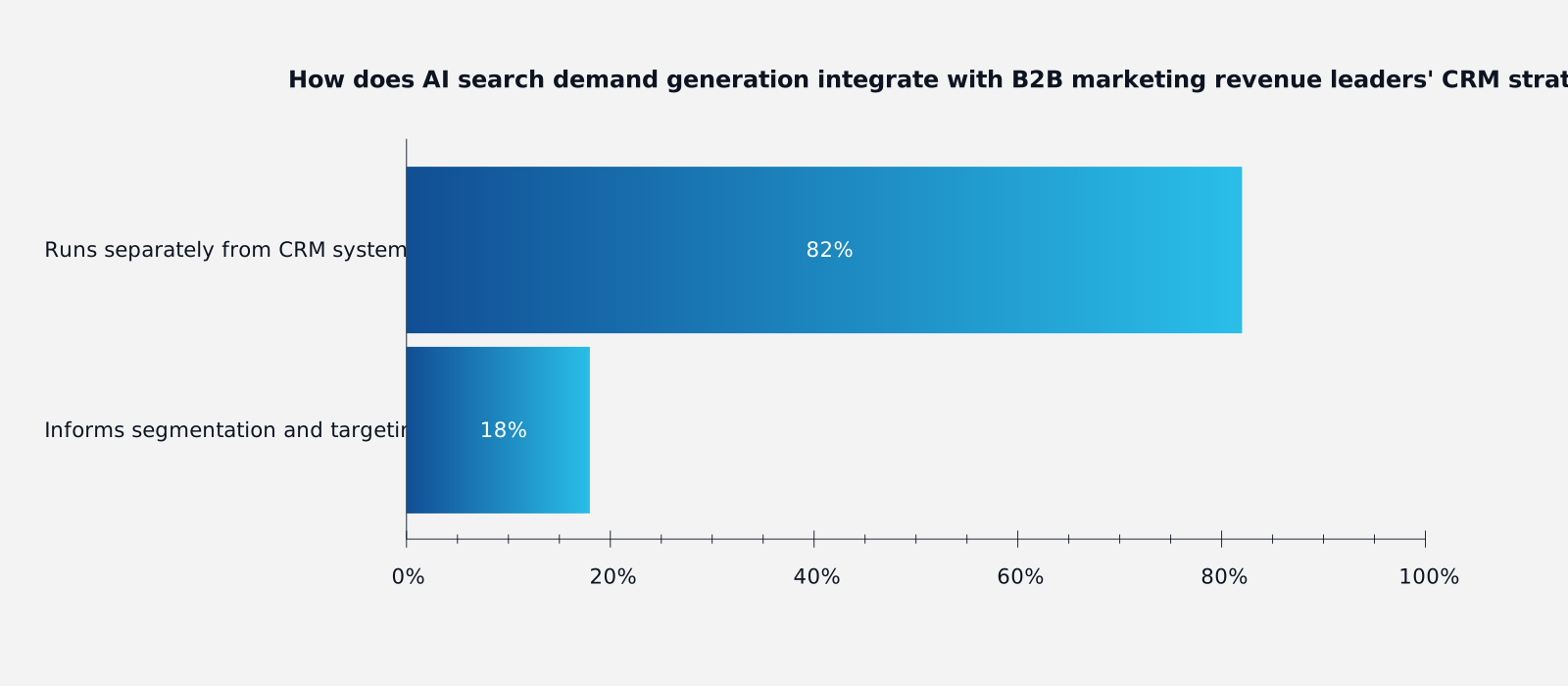
- For 82% of B2B marketing revenue leaders, AI search demand generation runs separately from their CRM systems, and for 18%, it informs their CRM segmentation and targeting
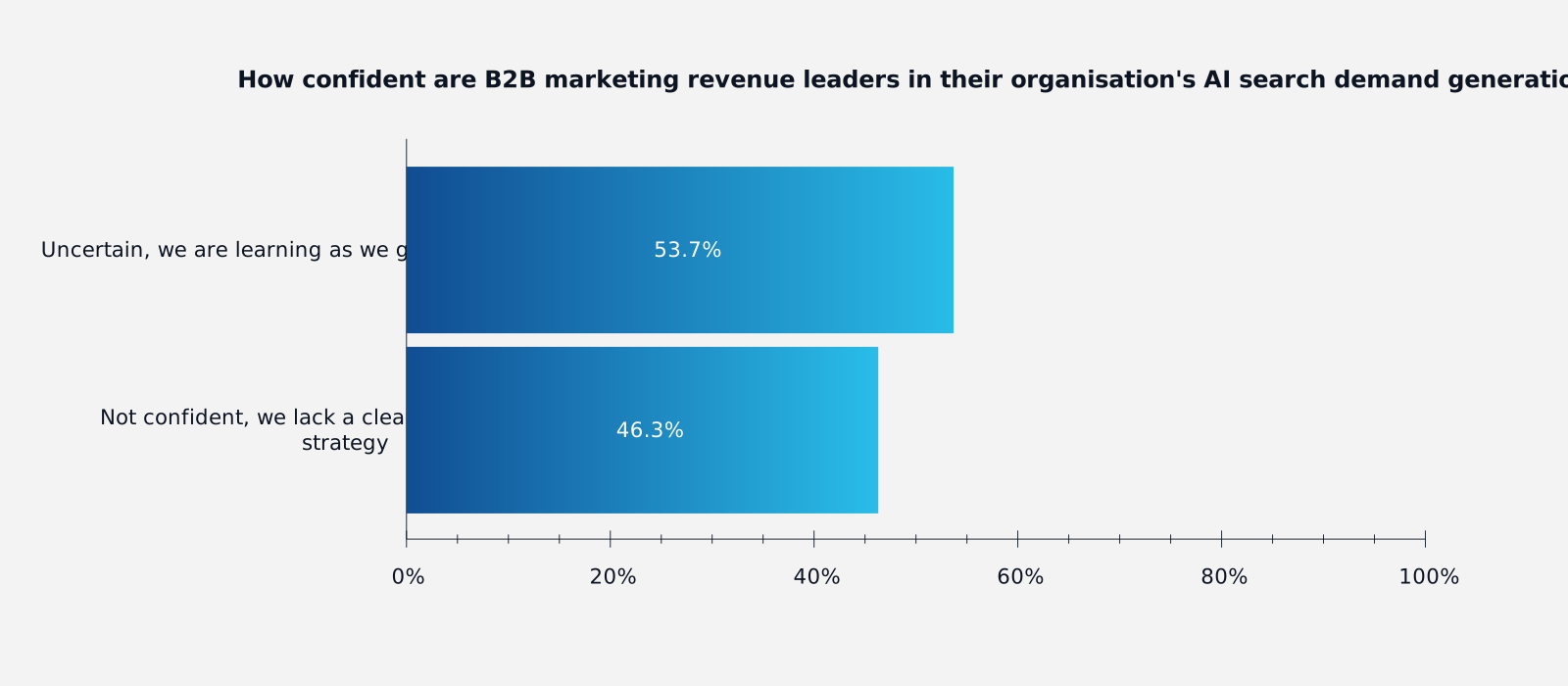
- 54% of B2B marketing revenue leaders are uncertain about their organisation’s AI search demand generation and are learning as they go, and 46% are not confident as they lack a clear strategy
- Managing consultancies are an essential external partner for 17% of B2B marketing revenue leaders in supporting their AI search demand generation strategy, and a helpful option for 33%, but they are not a preference for 49%, while fewer than 1% agree that traditional SEO or digital agencies are an essential partner
- 78% of B2B marketing revenue leaders evaluate agency partners for AI search demand generation work by their proven track record and case studies, and 22% look at their team expertise and certifications
- Measuring AI search demand generation
Methodology and data
Sourced using Artios from an independent sample of 130,452 opinions of B2B marketing revenue leaders in the UK across X, Quora, Reddit, Bluesky, TikTok, and Threads. Responses are collected within a 95% confidence interval and a 5% margin of error. Results come from what people describe and opinions expressed online, not from actual questions answered by people in the sample.
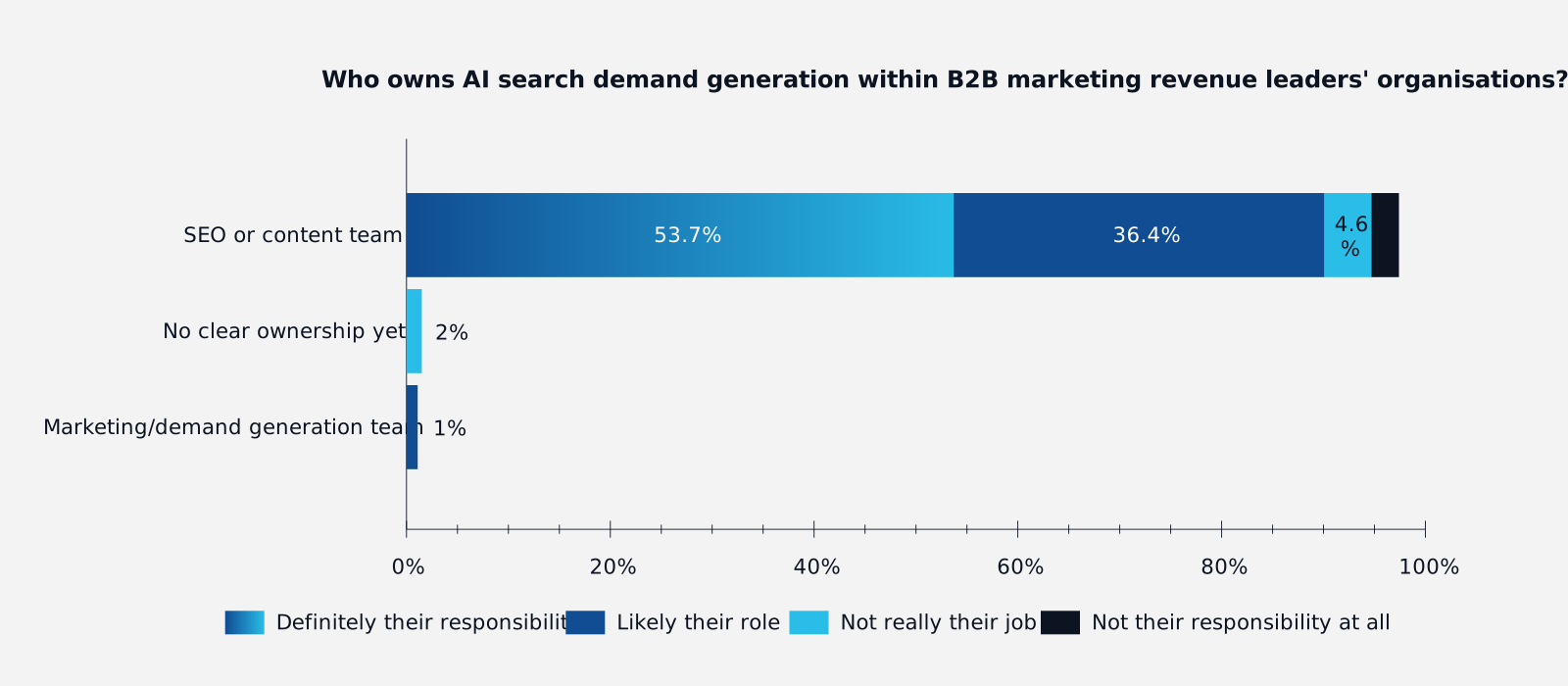
Who owns AI search demand generation within B2B marketing revenue leaders' organisations?
At 54% of B2B marketing revenue leaders’ organisations, the SEO or content team is definitely responsible for AI search demand generation; 36% agree these teams are likely to take responsibility, but 5% say it’s not really their job, and 3% agree it’s not their responsibility at all, while at 1% of leaders' organisations, the marketing or demand generation team owns AI search demand generation, and 2% have not yet assigned clear ownership.
SEO or content teams take the lead:
AI-powered search engines are having a significant impact on search engine optimisation (SEO) workflows. Engines like ChatGPT, Perplexity, and Google’s SGE are increasingly challenging traditional SEO practices while driving the growth of generative engine optimisation (GEO), where AI-generated responses directly address users’ queries without redirecting them to external sites.
In response, organic search, digital marketing, and content visibility strategies must pivot and integrate quickly to maintain click-through rates and overall user engagement. It comes as little surprise, then, that SEO and content teams are responsible for AI search demand generation in the vast majority of B2B marketing revenue leaders’ organisations.
54% of leaders note that the responsibility for AI search demand generation definitely lies with their SEO or content teams, and 36% say that this is likely within these teams’ scopes. Only 5% note that this task does not fully fall to their content and SEO teams, and just 3% say that it isn’t their responsibility at all.
Another 2% of B2B marketing revenue leaders aren’t able to share clear ownership of this responsibility at present, and an equal 2% agree that their marketing and demand generation teams have likely been tasked with generating AI search demand.
SEO and content teams seem to carry this responsibility in most organisations and are now tasked with integrating traditional SEO practices with key trends such as semantic search advancements and authoritative, conversational content to keep their work highly visible.
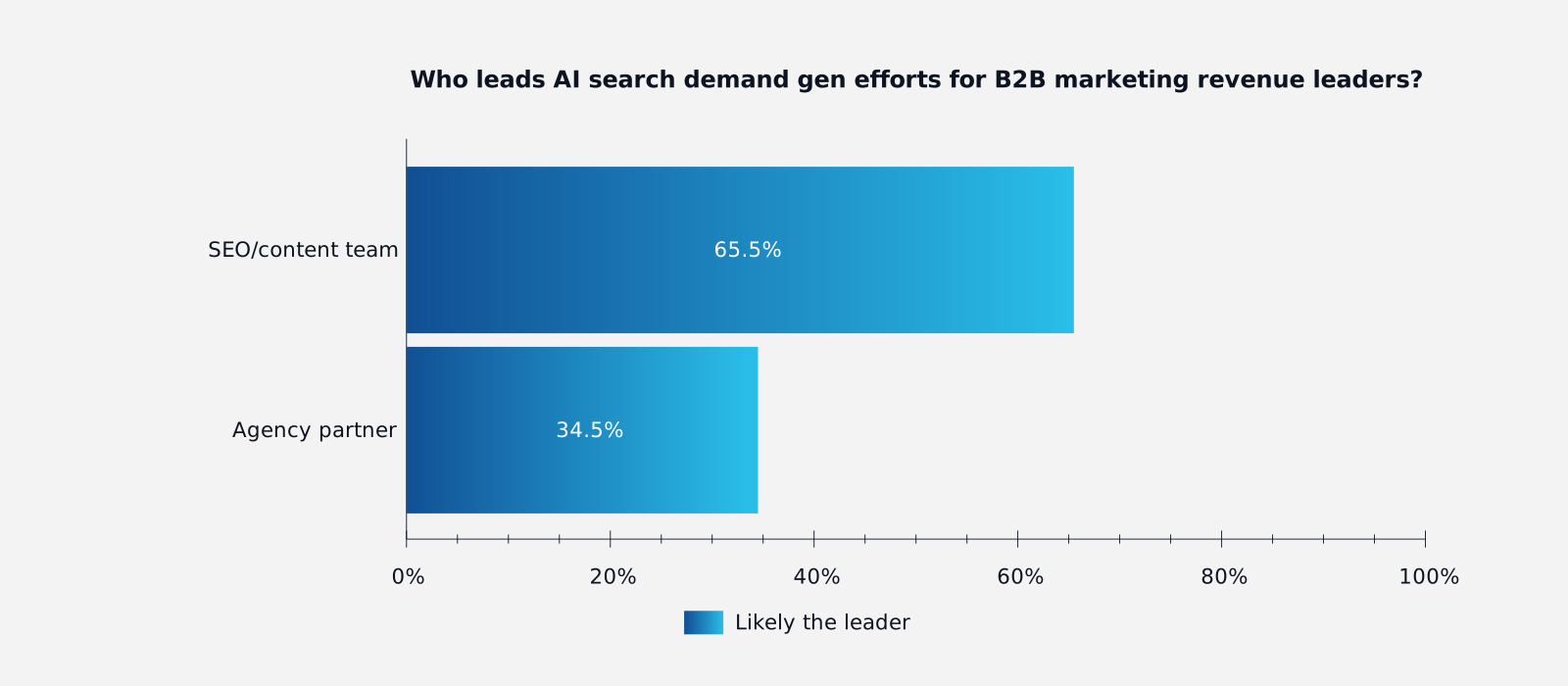
Who leads AI search demand gen efforts for B2B marketing revenue leaders?
65% of B2B marketing revenue leaders agree that their SEO or content team is likely the leader of their AI search demand generation efforts, and 35% cite an agency partner as their leader.
In-house leads ahead of external partners:
Given the growing body of research linking AI search to widespread shifts in SEO, it makes sense that SEO and content teams lead AI search demand generation. Just as these teams own this responsibility in many cases, SEO and content professionals handle these efforts in most B2B marketing organisations.
Our findings show that in 65% of organisations, SEO and content teams primarily lead AI search demand generation efforts. All B2B marketing revenue leaders who share this view note that these teams are likely to lead this critical department.
Some organisations also report that agency partners are pioneering their AI search demand generation workflows. 35% of our audience voiced this opinion, with the full contingent noting that their agency partners are most likely to lead their in-house AI search demand operations.
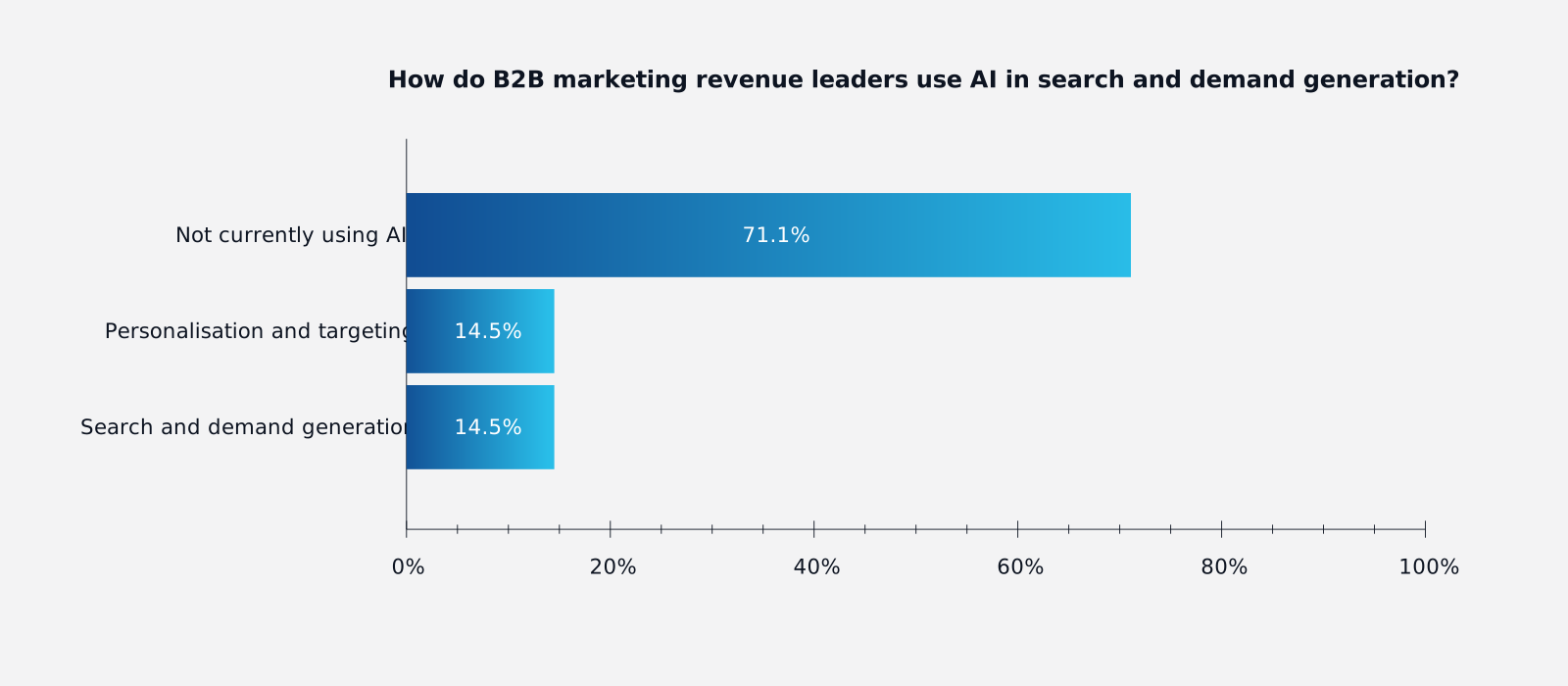
How do B2B marketing revenue leaders use AI in search and demand generation?
While 71% of B2B marketing revenue leaders are not currently using AI in demand generation, 14% are using it for personalisation and targeting, and another 14% are using AI for search and demand generation.
AI adoption has room for improvement:
According to the latest Demand Gen report, The State of B2B Marketing: Trends and Insights in 2026, as many as 96% of B2B marketers use AI tools to support their daily workflows, with 45% saying efficiency is the number-one benefit. However, the B2B marketing revenue leaders in our audience paint a different picture of AI usage for demand generation.
71% are not currently using AI in their search demand generation efforts, which starkly contrasts with the statistic above. On the other end of the spectrum, 14% of leaders use AI for targeting and personalisation, using real-time user behaviour analysis, data signals, and search intent information to scale their delivery of hyper-relevant content to their audiences.
Another 14% of leaders also use AI for search and demand generation itself. AI can optimise these tasks by evaluating user behaviours, predicting intent, and streamlining the delivery of personalised ads and content, potentially improving marketing ROI and conversion rates without additional manual input.
These capabilities may be key drivers behind its growing use in search and demand generation, as well as in targeting and personalisation efforts.
How do buyers discover B2B marketing revenue leaders via AI search demand generation?
97% of B2B marketing revenue leaders confirm that their buyers discover their brand via voice assistants, and 3% are discovered by direct AI chat queries.
Discovery is largely focused on voice search:
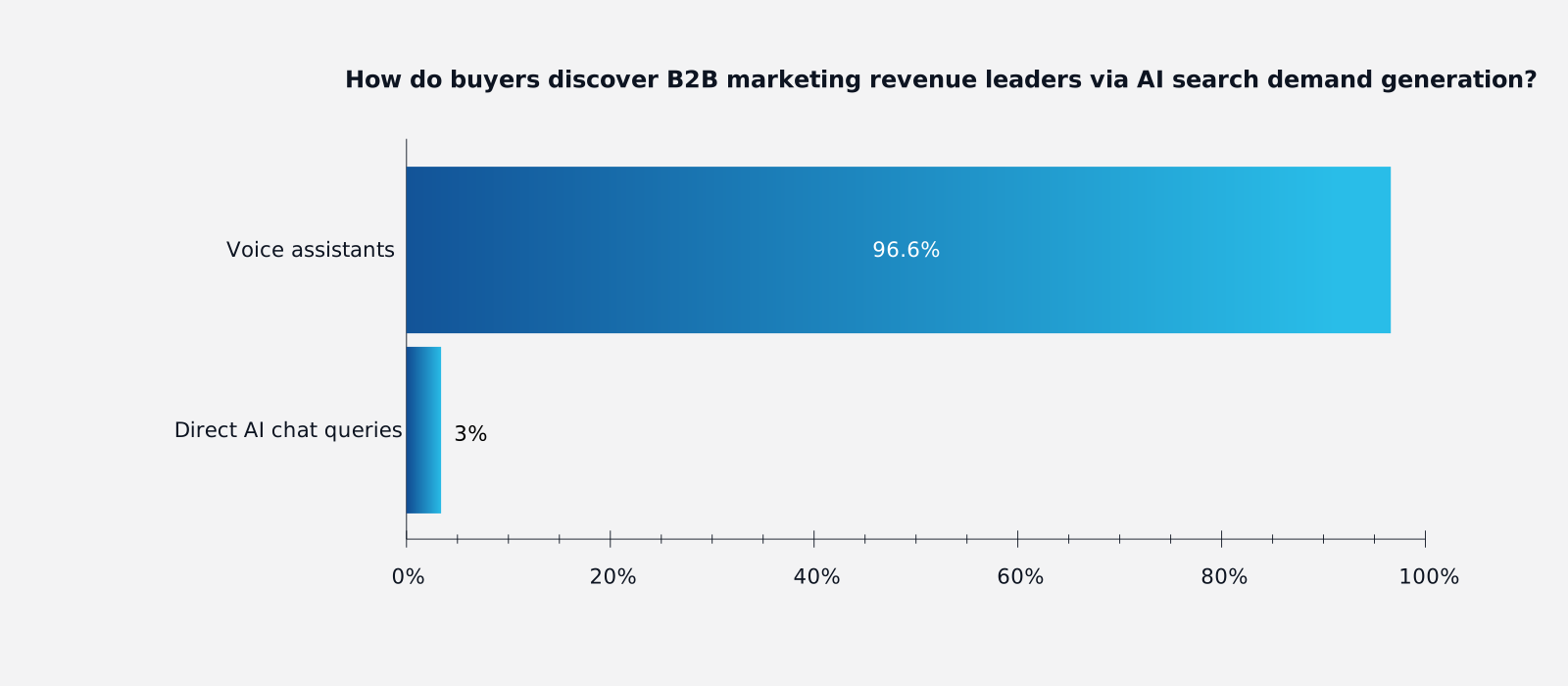
Voice assistants are the primary discovery tool buyers use to find B2B marketing revenue leaders in 2026, with 97% agreeing they are discovered this way through AI search demand generation. With the voice assistant market’s value expected to rise from US$7.35 billion in 2024 to US$33.74 billion by 2030, it stands to reason that voice assistants will continue to support discovery in the foreseeable future.
In contrast, just 3% of buyers discover leaders through AI search demand generation using direct AI chat queries. This may be because voice assistants integrate so simply and effectively into buyers’ daily lives, and because they can answer complex questions comprehensively on demand.
While AI chat queries can also provide in-depth answers, they require manual typing and a higher degree of concentration from users. This could be one of the key reasons why voice assistants seem to be the preferred discovery method among our audience’s buyers, producing similar results without the same time and input constraints.
Which AI search platforms matter most to B2B marketing revenue leaders' demand generation strategy?
For 20% of B2B marketing revenue leaders, ChatGPT or OpenAI search is essential to their demand generation strategy, and it’s a valuable addition for 46%, but not a priority for 9%, and it doesn't matter for 6%; for 7% Google AI overviews or Gemini are essential to their demand generation strategy, and 5% agree they're a valuable addition, but they are not a priority for 1%, while 3% name Perplexity as essential, and 3% view it as a valuable addition.
ChatGPT and OpenAI matter most for strategy:
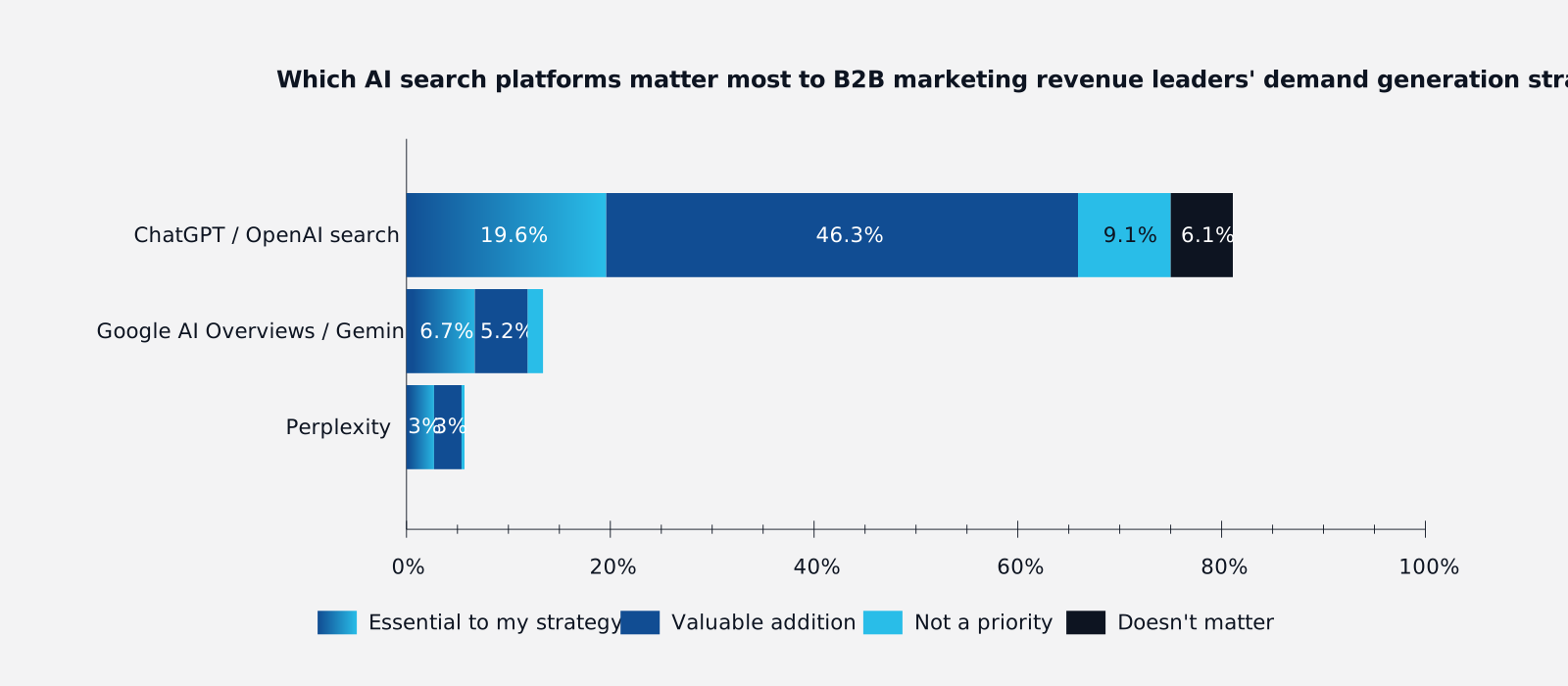
AI search platforms are increasingly forming essential parts of B2B marketing revenue leaders’ demand generation strategies. Their ability to analyse real-time buyer intent and deliver highly personalised content directly within AI search results can positively influence B2B purchase decisions. Just as importantly, they can also do so at the specific times when these decisions are being considered and made.
According to 66% of our audience, ChatGPT - 2025’s most-downloaded app with 770 million installs and 900 million weekly active users - is a key player in their demand generation strategies. For another 20%, it’s essential to their workflows, and 46% consider it a valuable addition, while only 9% feel that it’s not their top priority and just 6% feel that it has little importance to their strategies.
Some B2B marketing revenue leaders also turn to popular AI platforms like Google AI Overviews, Google Gemini, and Perplexity to refine their demand generation programmes.
Of those who use Google AI Overviews and Gemini, 7% consider it a non-negotiable tool, 5% believe that it adds significant value, and only 1% don’t consider it a priority, while none feel that it’s of no importance to their workflows. 3% of Perplexity users view it as essential to their strategies, and 3% see it as a valuable addition, while fewer than 1% rank it low on their priority lists.
How are B2B marketing revenue leaders measuring AI search demand generation performance?
65% of B2B marketing revenue leaders are measuring AI search demand generation performance by brand mentions and citations in AI outputs, and 35% are measuring it in referral traffic from AI search platforms.
Mentions and referrals stand out as metrics:
Measuring the performance of AI search demand generation efforts is critical for success. It provides quantifiable insights into how effectively content impacts buyers’ intent, ensuring resources are allocated to the channels that drive the biggest revenue gains in the long run.
But how exactly do B2B marketing revenue leaders measure the performance and results of their AI search demand generation practices? Our audience prefers two key methods: measuring brand mentions and citations in AI outputs, and gauging referral traffic from their AI search platforms of choice.
65% measure AI search demand generation performance through AI citations and brand mentions, while 35% rely on referral traffic volumes to pinpoint the efficacy of their efforts.
Both are valuable performance measurement tools. That said, AI platforms’ in-depth, summarised answers provide direct visibility into traffic, making them an exceptionally reliable and accessible metric of a brand’s reach. This could help to explain, in part, why nearly two-thirds of B2B marketing organisations use them to evaluate their search demand generation performance.
How does AI search demand generation integrate with B2B marketing revenue leaders' CRM strategy?
For 82% of B2B marketing revenue leaders, AI search demand generation runs separately from their CRM systems, and for 18%, it informs their CRM segmentation and targeting.
AI and CRM integration is still limited:
Recent studies on AI applications in customer relationship management outline a series of recommended steps for successfully integrating AI search demand generation with CRM strategies. The suggested phases include AI-CRM integration planning, data governance and user training, implementation and management, and, finally, ongoing performance evaluation and improvement of the integrated system.
This strategic integration process is recommended for a seamless and scalable result. But based on our numbers, it may still take time for AI-CRM integration to become widespread in the industry.
82% of B2B marketing revenue leaders’ AI search demand generation processes run entirely separately from their CRM systems, with little to no integration at present. Only 18%’s demand generation flows inform their customer segmentation and targeting efforts. With broader integration, leaders could link buyer intent directly to prospect profiles, automating highly personalised lead nurturing that drives increased conversions and loyalty over time.
How confident are B2B marketing revenue leaders in their organisation's AI search demand generation strategy?
54% of B2B marketing revenue leaders are uncertain about their organisation’s AI search demand generation and are learning as they go, and 46% are not confident as they lack a clear strategy.
Confidence is still shaky:
Responsiveness to customers’ needs, strong relationships, and solutions that offer real results have long been the cornerstones of B2B sales success. While they are still of vital importance, thought leaders like McKinsey have identified a new factor that is becoming undeniably imperative for sustainable growth: AI.
Integrating agentic AI effectively into sales journeys allows organisations to deepen client relationships and deliver solutions that provide genuine value, but certain conditions apply. Most B2B companies already rely on AI, but those suffering from data fragmentation, overreliance on manual processes, team disconnection, and incomplete insights may not see the same benefits.
Once these issues are addressed, AI can prove to be an invaluable tool, particularly for refining AI search demand generation strategies. This in turn improves B2B marketing revenue leaders’ (and their teams’) confidence in these strategies. However, leaders’ confidence in their programmes seems divided, and they have yet to reach high levels of conviction.
Among our audience, 46% of B2B marketing revenue leaders report that they don’t feel confident in their AI search demand generation strategy at all, and admit that they lack a clear strategy to start with. The remaining 54% aren’t sure how confident they are in their strategies and are still in the learning process.
By improving team collaboration, enhancing insights, and automating processes, these leaders may build more comprehensive strategies that inspire trust in themselves and their human capital.
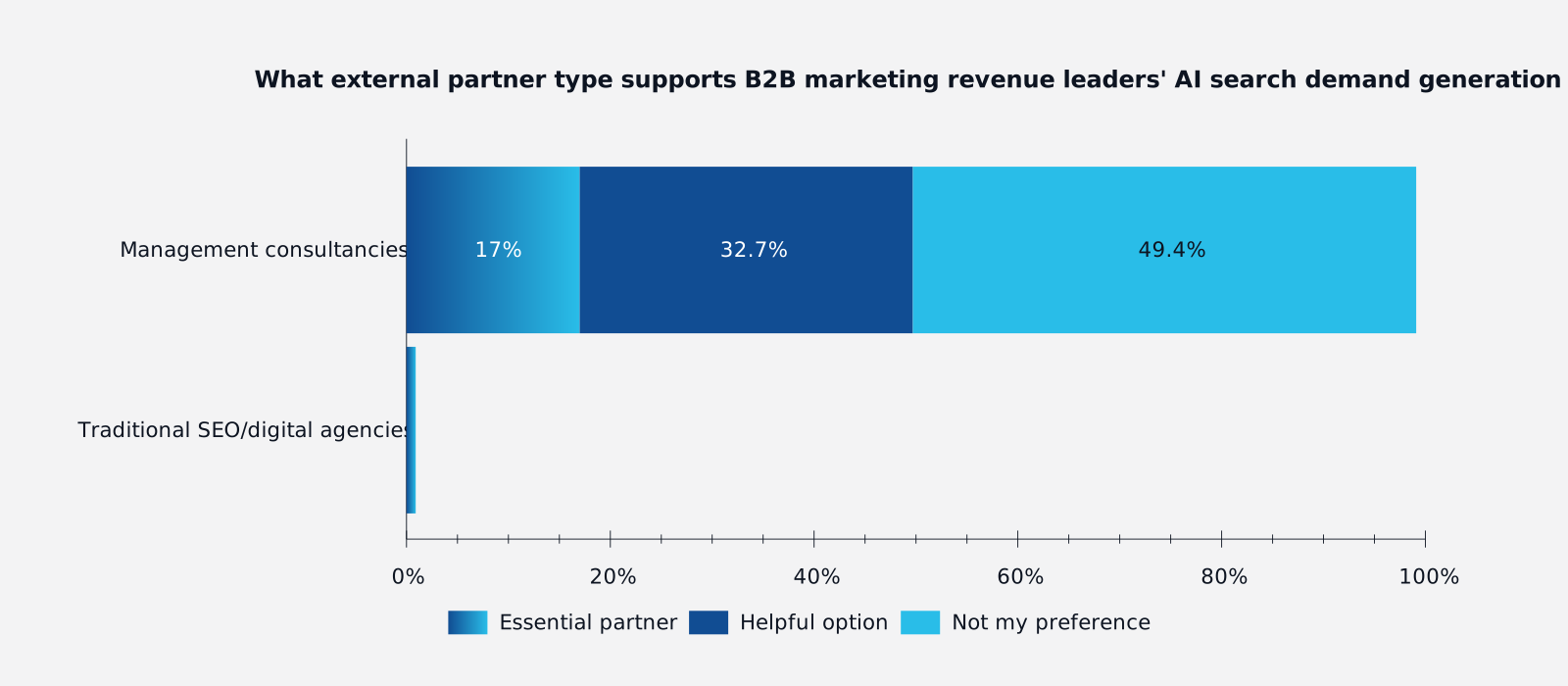
What external partner type supports B2B marketing revenue leaders' AI search demand generation strategy?
Managing consultancies are an essential external partner for 17% of B2B marketing revenue leaders in supporting their AI search demand generation strategy, and a helpful option for 33%, but they are not a preference for 49%, while fewer than 1% agree that traditional SEO or digital agencies are an essential partner.
External partner support is not one-size-fits-all:
External partners can strengthen and enhance AI search demand generation strategies, especially when they are uniquely specialised in the field. Traditional SEO and digital agencies have long served this role, but our audience seems to prefer management consultancies for AI strategies in particular.
17% of B2B marketing revenue leaders choose management consultancies to strengthen their AI search demand generation strategies, and 33% consider these consultancies helpful sources of support. That’s 50% in total who rely on management consultancies to support their demand generation efforts. By the same token, nearly as many (49%) say these consultancies are not their first choice when seeking invaluable support.
Traditional SEO and digital agencies sit at the other end of the spectrum, with just under 1% of leaders turning to these firms to strengthen their AI search demand generation workflows.
While our audience’s views on the usefulness of management consultancies are split, they still seem to be the preferred option for external partnerships.
How do B2B marketing revenue leaders evaluate agency partners for AI search demand generation work?
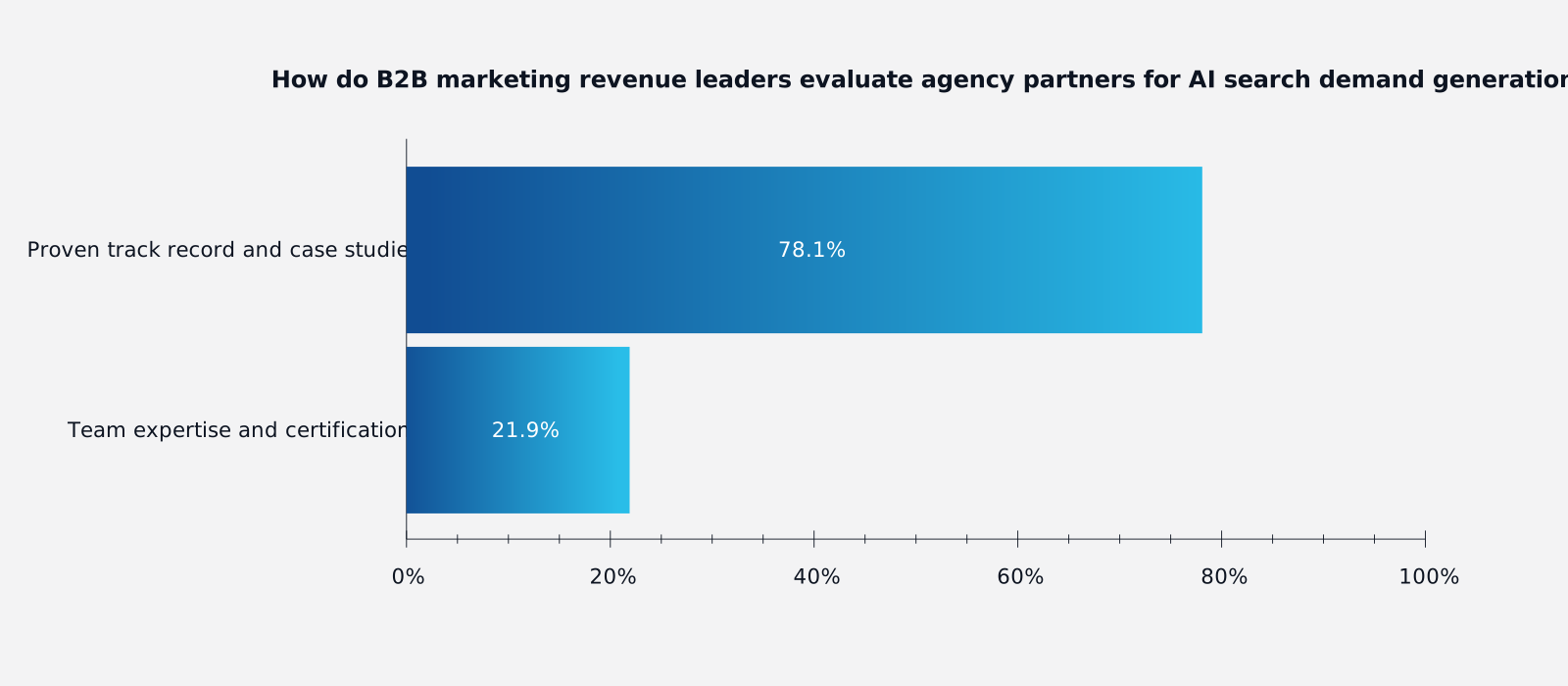
78% of B2B marketing revenue leaders evaluate agency partners for AI search demand generation work by their proven track record and case studies, and 22% look at their team expertise and certifications.
Evaluation centres on four core aspects:
The opinions above suggest a clear preference for management consultancies as search demand generation strategy agency partners. When evaluating potential partners, B2B marketing revenue leaders most value a proven track record supported by substantiated case studies.
At 78%, most of our audience uses in-depth case studies and a proven track record to differentiate between agency partners and choose the right fit for their organisations. Additionally, 22% look at an agency team’s expertise, credentials, and certifications when making their decision.
Judging by the numbers, while technical certifications and credentials can certainly offer peace of mind, solid evidence of past performance and compelling results is the ultimate factor that B2B marketing revenue leaders rely on to choose reputable partners.
Measuring AI search demand generation
These statistics illustrate that AI search demand generation remains an emerging area for many B2B marketing revenue leaders, with gaps in strategy, CRM integration and performance measurement. SEO and content teams play a central role, while ChatGPT is a key platform for demand generation. External partners also play a role, with proven results and relevant case studies helping leaders assess their suitability.
Going forward, B2B teams will need to refine how they use AI search, measure its impact and adapt their strategies as the role of AI in the buying journey develops.

Send to your email
Enter your email below and a link to download the PDF of this article will be sent directly to your inbox.