AI Search B2B Buying Group Statistics: UK 2026


Send to your email
Enter your email below and a link to download the PDF of this article will be sent directly to your inbox.

AI search is becoming a bigger part of how B2B buying groups research suppliers and compare solutions. As tools like ChatGPT and Gemini play a larger role in discovery, making your brand visible in the age of AI becomes increasingly important. Brands need to understand how they appear within those AI-led journeys and what influences whether they are surfaced at all. For B2B marketing revenue leaders, this creates a new challenge around how buyers discover information and which brands make it into the conversation.
To find out what 224,003 opinions of B2B marketing revenue leaders in the UK were about AI search B2B buying groups, we utilised AI-driven audience profiling to synthesise insights from online discussions over 12 full months ending September 23rd, 2026, to a high statistical confidence level. The results illustrate how B2B marketing revenue leaders view AI search’s role in buying group research, brand visibility and supplier discovery, as well as the challenges they face in measuring and responding to this shift.
Index
- Methodology and data
- ChatGPT has a major influence on 37% of B2B marketing revenue leaders’ AI search B2B buying groups, some influence on 17%, and a minor influence on 1%, but no influence on another 1%; Microsoft Copilot has a major influence on 20% of AI search B2B buying groups and some influence on 6%, while Perplexity has a major influence on 12% and some on 5%; Google AI overviews don’t get any mentions regarding their influence
- 54% of B2B marketing revenue leaders are not confident that their brand appears in AI search B2B buying group queries, but more positively, 46% are very positive that their brand appears in these queries
- For 98% of B2B marketing revenue leaders, financial services is the industry vertical that shows the strongest AI search B2B buying group activity, and for 2%, technology and SaaS is the vertical that shows the strongest activity
- For 11% of B2B marketing revenue leaders, paid search advertising is the channel that loses influence the fastest to the AI search B2B buying group; this channel also seems to lose influence quickly for 17%, but 32% find that paid search loses influence slowly, and 20% feel that it barely loses influence; in comparison, email marketing loses influence the fastest for 7%, 7% find that it loses influence quickly, and a further 7% feel that it loses influence slowly
- 77% of B2B marketing revenue leaders’ CRMs capture AI search B2B buying group signals using only manual sales notes, and 23% have custom fields for AI-sourced leads
- When looking at tools to improve AI search B2B buying group tracking, advanced attribution software would offer an essential upgrade for 35% of B2B marketing revenue leaders, and a customer journey mapping tool would provide an essential upgrade for 33%; however, 32% of leaders don’t feel any other tools are needed for improvement
- ChatGPT is recommended by 23% of B2B marketing revenue leaders for training AI search B2B buying group content teams, and 32% agree it is a solid option, but it is not preferred by 19%, and 5% would not use it for training, while 3% recommend using Claude and 5% find it a solid option, 1% do not prefer it; 2% recommend Gemini, 4% find it a solid option, and another 1% wouldn't recommend it; and just 2% concur that Perplexity is a solid training option
- Local regulatory references matter for 72% of B2B marketing revenue leaders’ UK AI search B2B buying groups, but for 28%, no specific nuance is required
- AI search’s growing role in B2B buying
Methodology and data
Sourced using Artios from an independent sample of 224,003 opinions of B2B marketing revenue leaders in the UK across X, Quora, Reddit, Bluesky, TikTok and Threads. Responses are collected within a 95% confidence interval and a 5% margin of error. Results are derived from what people describe online, from opinions expressed, not from actual questions answered by people in the sample.
Which AI search platforms influence B2B marketing revenue leaders' AI search B2B buying group?
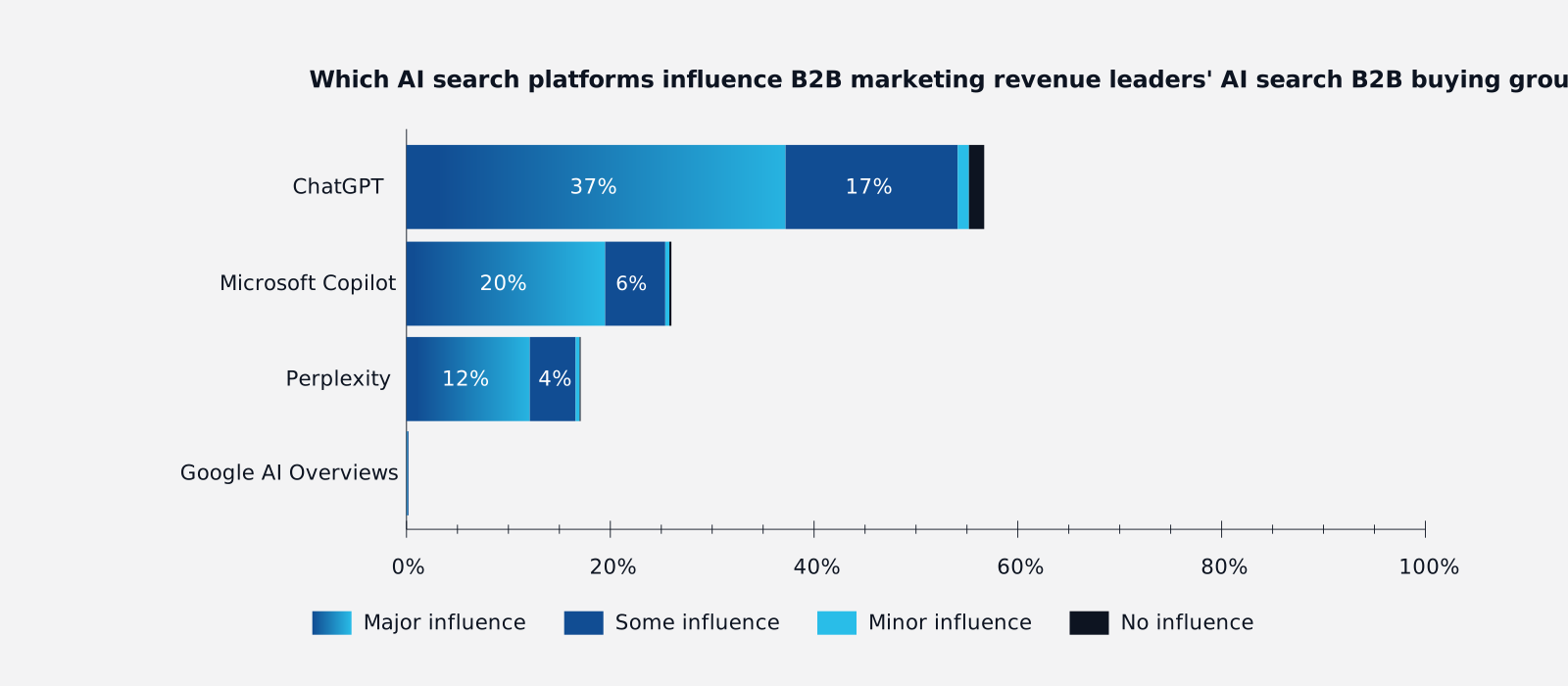
ChatGPT has a major influence on 37% of B2B marketing revenue leaders’ AI search B2B buying groups, some influence on 17%, and a minor influence on 1%, but no influence on another 1%; Microsoft Copilot has a major influence on 20% of AI search B2B buying groups and some influence on 6%, while Perplexity has a major influence on 12% and some on 5%; Google AI overviews don’t get any mentions regarding their influence.
Familiar AI tools are becoming part of the buying conversation:
AI search platforms are becoming an increasingly important influence on B2B buying groups, but their impact is far from uniform. AI is already part of the purchase research process for 73% of B2B buyers, giving these tools a growing role in how buying decisions are informed.
ChatGPT has the strongest influence among B2B marketing revenue leaders’ buying groups. It’s a major influence for 37%, has some influence for 17%, a minor influence for 1%, and no influence for another 1%. Its reach gives it the greatest potential to shape early research and supplier consideration.
Microsoft Copilot is a major influence for 20% of our audience, has some influence for 6%, and a minor influence for less than 1%. Its impact may be strengthened by its presence inside tools already used during day-to-day business research.
Perplexity is a major influence for 12%, has some influence for 5%, and a minor influence for less than 1%. Its research-led format can make it useful when buyers want concise answers supported by source links.
No opinions were expressed about Google AI Overviews, but this doesn’t mean they have no influence. It simply means they weren’t mentioned in the online conversations analysed.
How confident are B2B marketing revenue leaders that their brand appears in AI search B2B buying group queries?
54% of B2B marketing revenue leaders are not confident that their brand appears in AI search B2B buying group queries, but more positively, 46% are very positive that their brand appears in these queries.
AI search visibility is becoming harder for brands to take for granted:
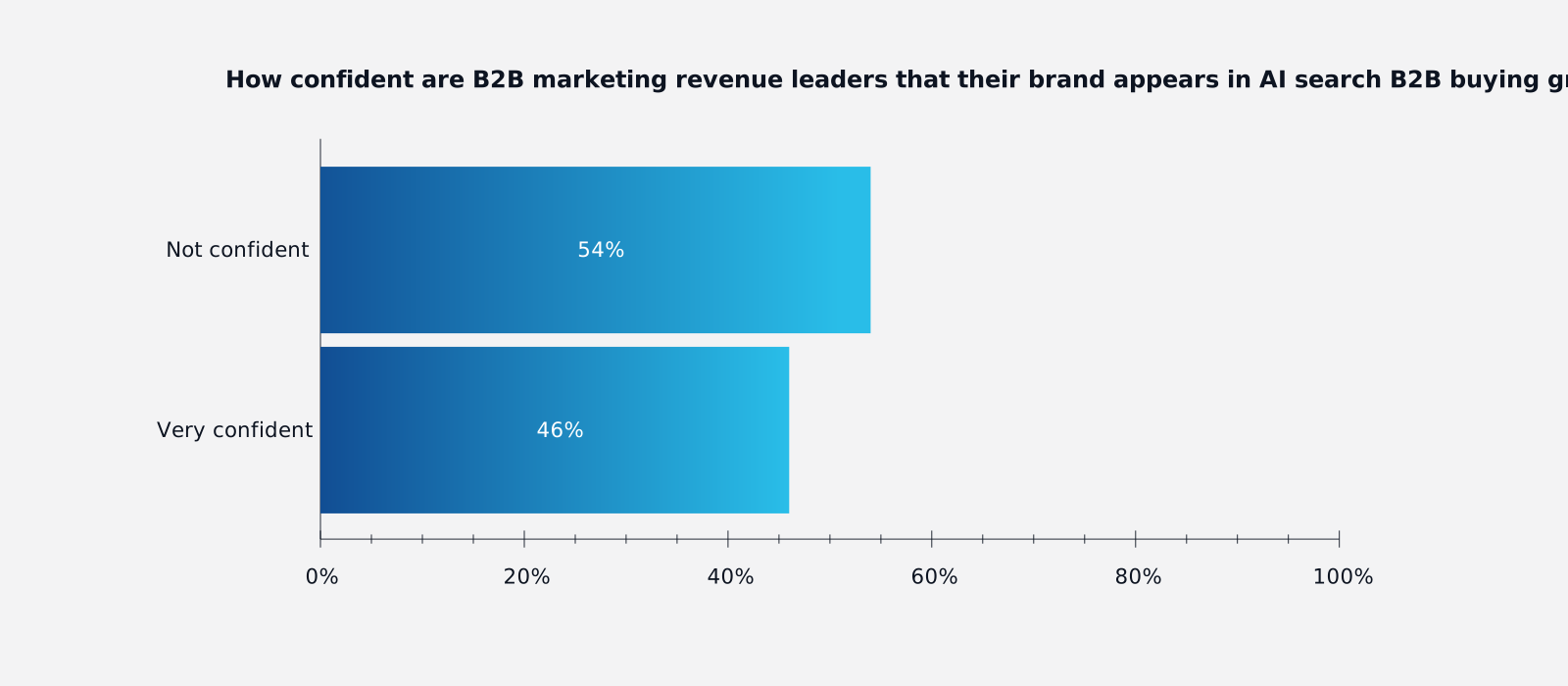
B2B marketing revenue leaders are closely divided over how confident they are that their brand appears in AI search buying-group queries. 54% are not confident. New research from PwC Strategy& found that 94% of B2B buyers use large language models during the buying process, yet AI-generated answers typically cite only three to four brands. It also found that 40% to 60% of citations change each month.
When visibility is selective and fluid, it becomes harder for leaders to know whether their brand will appear consistently when buyers ask relevant questions, especially across different stages of the research process.
The remaining 46% of our audience are very confident that their brand appears in these queries. Stronger confidence is more likely when businesses are actively monitoring how they surface across different prompts and checking whether their brand appears in the right context.
Confidence also depends on understanding how frequently that visibility changes, rather than assuming that appearing once means the brand will continue to be surfaced when buyers return with new questions.
Which industry vertical shows strongest AI search B2B buying group activity for B2B marketing revenue leaders?
For 98% of B2B marketing revenue leaders, financial services is the industry vertical that shows the strongest AI search B2B buying group activity, and for 2%, technology and SaaS is the vertical that shows the strongest activity.
Different sectors are moving at very different speeds:
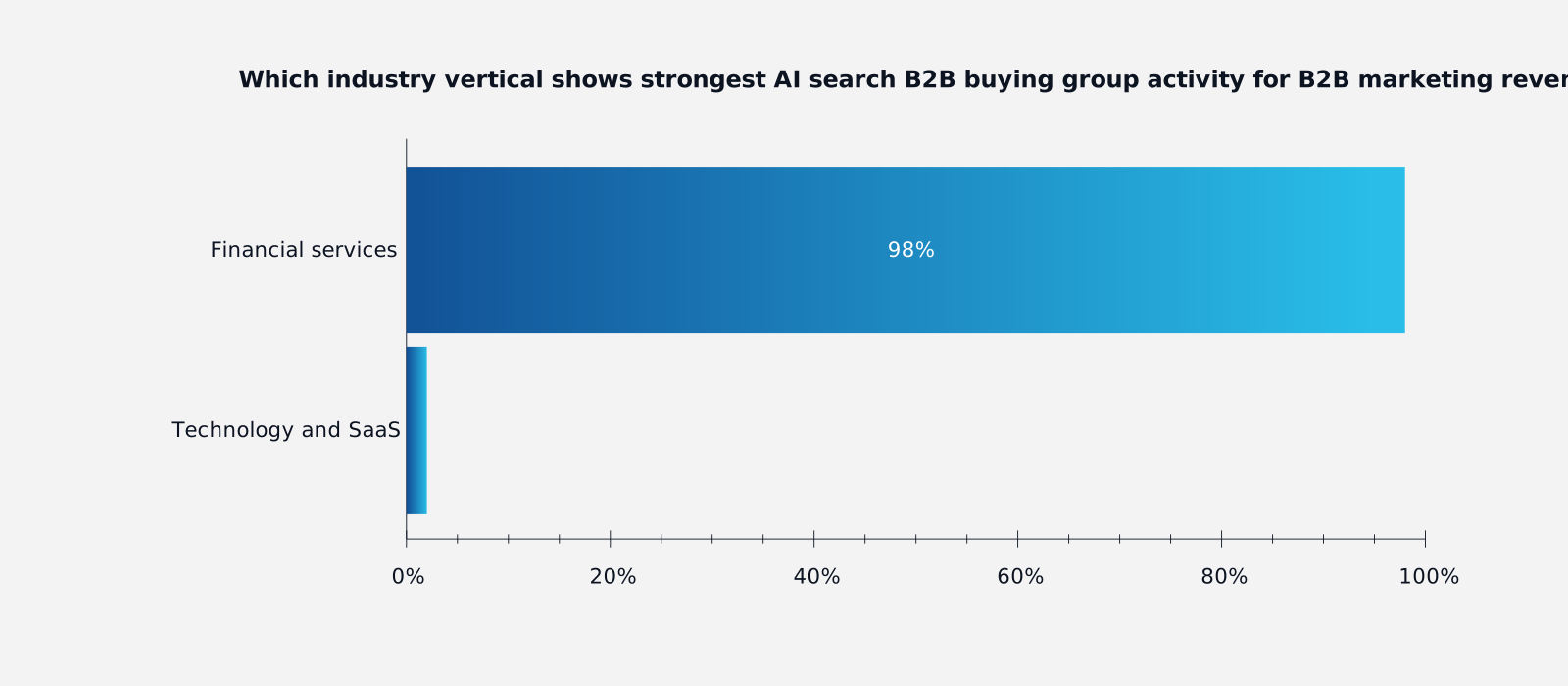
According to 98% of our audience, the industry vertical showing the strongest AI search B2B buying group activity among B2B marketing revenue leaders is financial services. AI search is clearly playing a major role in how buying groups in this sector research providers and weigh up their options.
In a market where trust and credibility are critical, appearing during AI-led research can help determine which brands make it into early consideration. This makes AI visibility especially valuable early in the journey, while buying groups are still narrowing the field.
Technology and SaaS account for just 2% of activity among B2B marketing revenue leaders. This is particularly interesting given wider B2B research. A recent Demand Gen Report found that 80% of technology buyers use GenAI at least as much as traditional search for vendor research, 21 percentage points higher than buyers in other industries. It also found that 56% of tech buyers use chatbots as a top source for discovering new vendors, compared with 28% across other industries.
Clearly, strong AI adoption within a sector doesn’t always translate into the same level of buying-group activity among every audience.
For B2B marketing revenue leaders, which channel loses influence fastest to the AI search B2B buying group?
For 11% of B2B marketing revenue leaders, paid search advertising is the channel that loses influence the fastest to the AI search B2B buying group; this channel also seems to lose influence quickly for 17%, but 32% find that paid search loses influence slowly, and 20% feel that it barely loses influence; in comparison, email marketing loses influence the fastest for 7%, 7% find that it loses influence quickly, and a further 7% feel that it loses influence slowly.
Traditional channels are losing some of their grip:
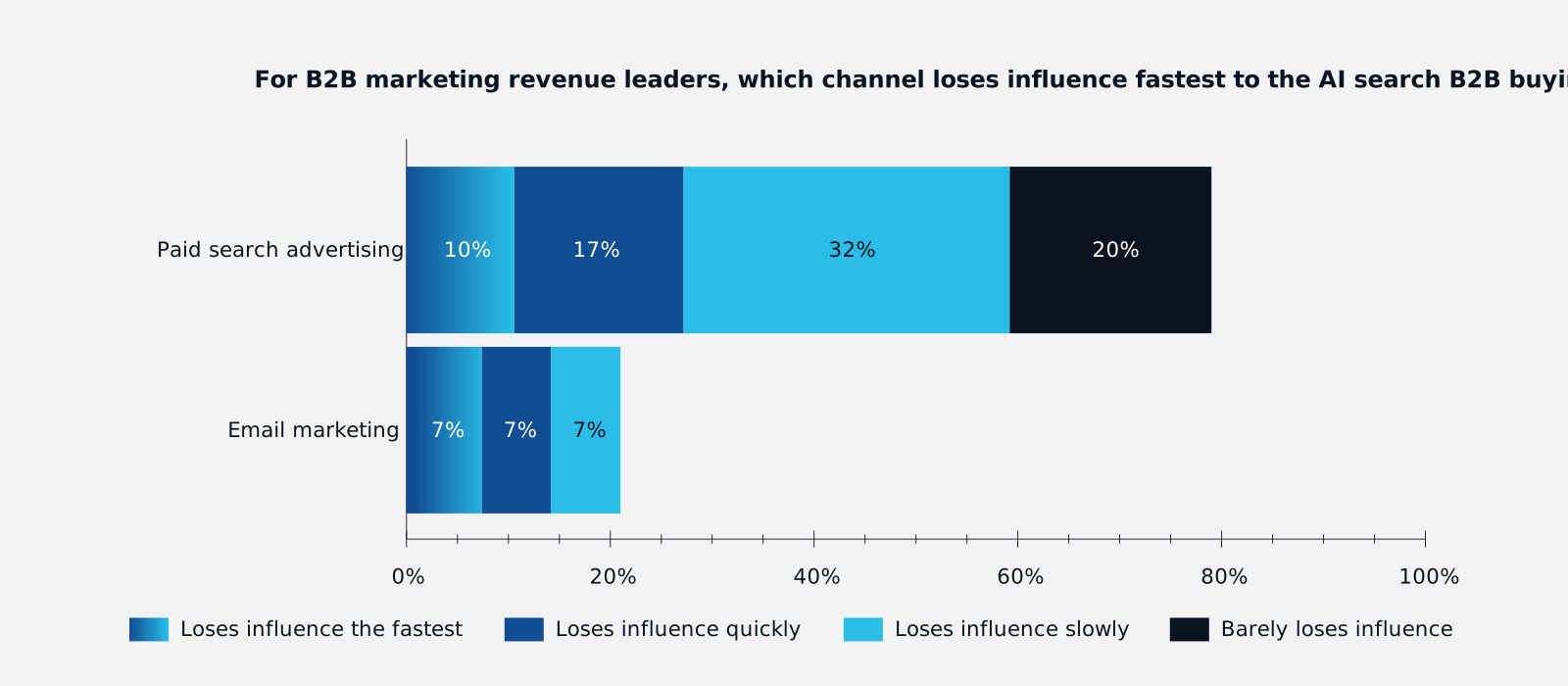
Paid search advertising is the channel losing influence fastest to AI search B2B buying groups. It loses influence the fastest for 11% of B2B marketing revenue leaders, quickly for 17%, slowly for 32%, and barely at all for 20%.
Seer Interactive found that paid click-through rates fell by around 12 percentage points when AI Overviews appeared in the SERP, dropping from 21.27% to 9.87%. This gives the shift a clear behavioural dimension. As AI answers occupy more of the search journey, paid ads have fewer opportunities to capture attention before buyers get the information they need.
Email marketing loses influence the fastest for 7% of our audience, quickly for another 7%, and slowly for a further 7%. Its decline is less pronounced because email reaches buyers directly rather than competing inside a search results page.
Influence can still weaken, though, if AI search answers questions earlier in the buying process and reduces the need for buyers to engage with follow-up content later. For marketers, the challenge is making email useful enough to add context or value that AI search alone does not provide.
How do B2B marketing revenue leaders' CRMs capture AI search B2B buying group signals?
77% of B2B marketing revenue leaders’ CRMs capture AI search B2B buying group signals using only manual sales notes, and 23% have custom fields for AI-sourced leads.
AI search signals can get lost if the CRM cannot use them:
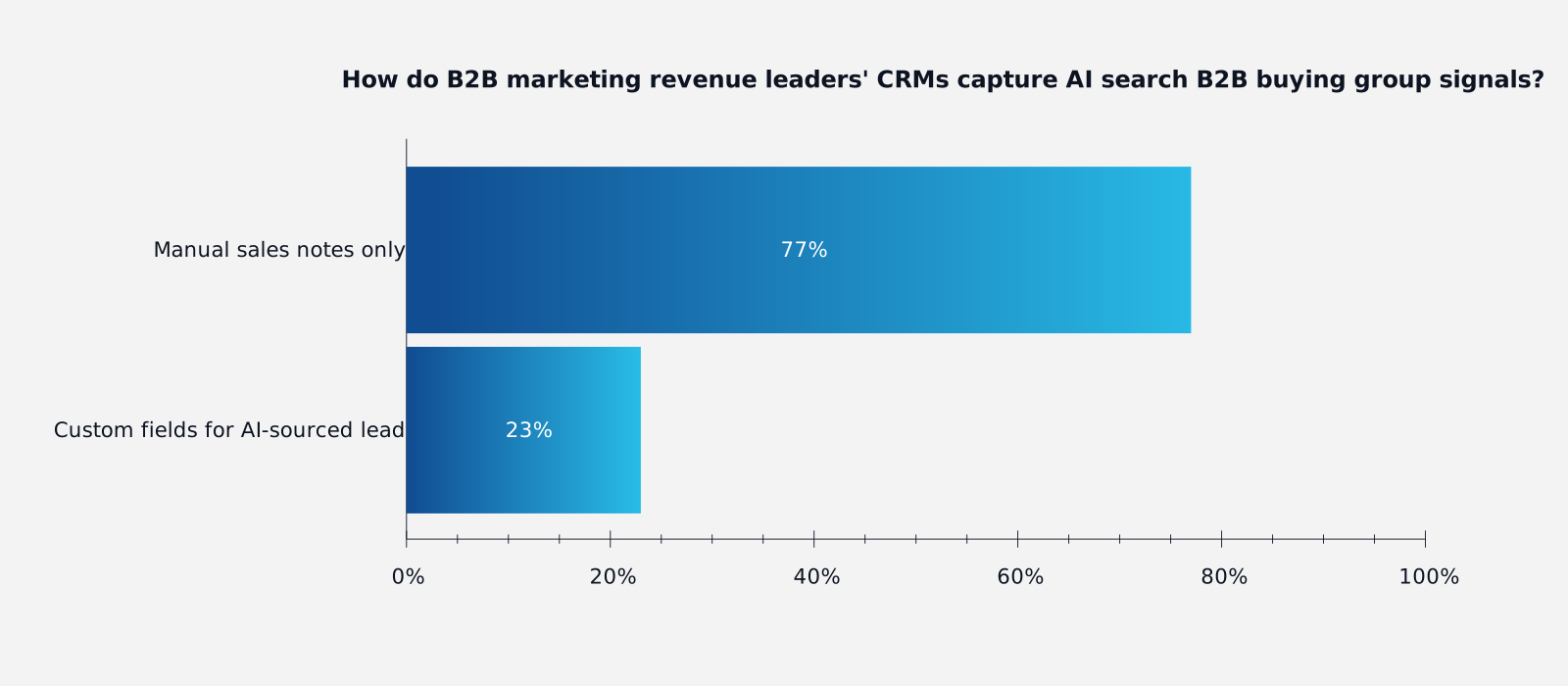
B2B marketing revenue leaders are still capturing AI search buying-group signals in relatively basic ways. For 77%, CRM capture relies on manual sales notes only. New research from McKinsey into B2B sales highlights the limits of leaving valuable information in unstructured notes, explaining how voice-to-CRM tools can turn meeting content into structured data that is easier to act on. The same principle applies here. If AI-search signals stay buried in free-text notes, they are harder to compare across leads or use consistently in reporting.
The remaining 23% use custom fields for AI-sourced leads. This creates a more structured way to identify where AI may have influenced discovery and gives marketing or revenue teams a clearer basis for tracking patterns over time. It can also reveal whether AI-sourced prospects progress differently through the pipeline, giving teams a better understanding of the commercial value behind those signals.
Structured fields make it easier to connect AI-search activity with pipeline data, rather than relying on individual salespeople to record the right detail in the right place.
Which tool would most improve AI search B2B buying group tracking for B2B marketing revenue leaders?
When looking at tools to improve AI search B2B buying group tracking, advanced attribution software would offer an essential upgrade for 35% of B2B marketing revenue leaders, and a customer journey mapping tool would provide an essential upgrade for 33%; however, 32% of leaders don’t feel any other tools are needed for improvement.
There is no single answer to better AI search tracking:
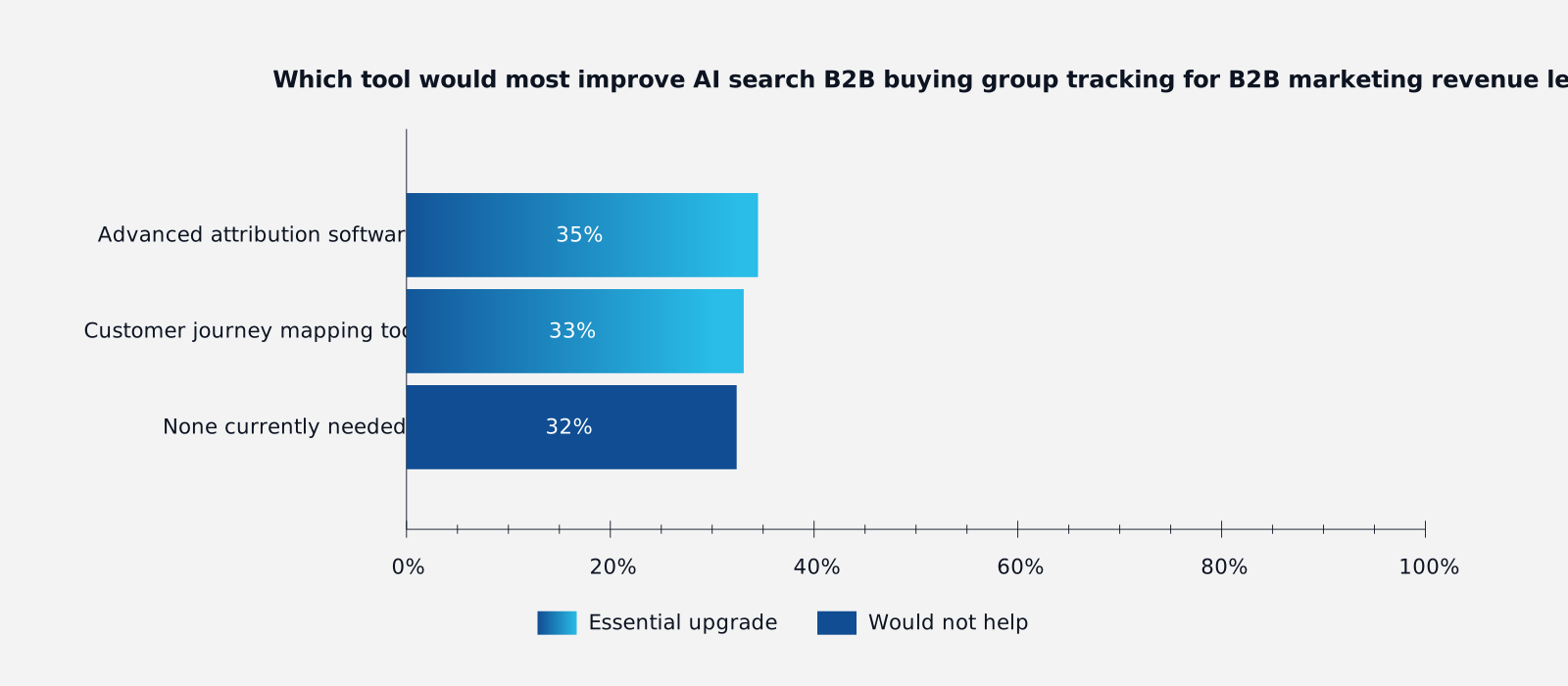
B2B marketing revenue leaders are almost evenly split on which tool would most improve AI search buying-group tracking. 35% see advanced attribution software as an essential upgrade. This points to a need for clearer visibility into which interactions are influencing pipeline and where AI search fits within the wider buying journey.
More advanced attribution helps teams connect AI-influenced discovery with later outcomes, giving them a clearer view of whether those early interactions are contributing to qualified leads or revenue.
A customer journey mapping tool follows closely, with 33% considering it an essential upgrade. A 2025 academic paper on AI and customer journey mapping argues that AI agents are changing how customers move through the buying journey, creating more dynamic paths across different touchpoints.
Journey mapping can help teams follow those changing paths more closely and understand where AI search is influencing progression from initial research through to later buying decisions.
The remaining 32% of B2B marketing revenue leaders don’t currently need another tool because it wouldn’t help. They may already be getting enough visibility from existing CRM data or reporting processes, so another platform could simply add more information to manage.
Which AI tool trains B2B marketing revenue leaders' AI search B2B buying group content team?
ChatGPT is recommended by 23% of B2B marketing revenue leaders for training AI search B2B buying group content teams, and 32% agree it is a solid option, but it is not preferred by 19%, and 5% would not use it for training, while 3% recommend using Claude and 5% find it a solid option, 1% do not prefer it; 2% recommend Gemini, 4% find it a solid option, and another 1% wouldn't recommend it; and just 2% concur that Perplexity is a solid training option.
Different AI tools suit different ways of working:
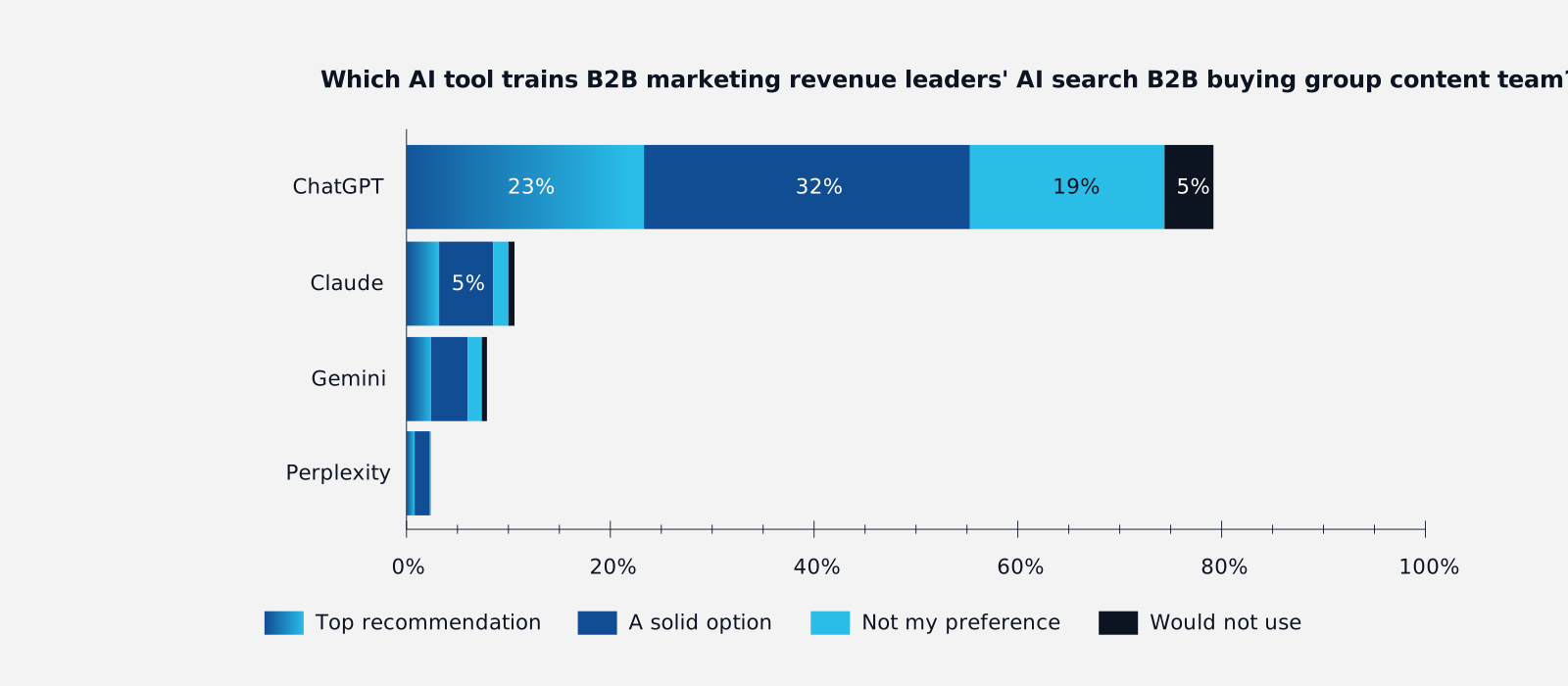
When B2B marketing revenue leaders choose an AI tool to train their AI search buying-group content teams, ChatGPT is the strongest overall option. It’s the top recommendation for 23%, and a solid option for 32%, although it’s not the preference for 19% and 5% wouldn’t use it. Its appeal likely comes from its versatility across brainstorming, drafting, rewriting and research, giving teams one tool that can support a wide range of content tasks.
Claude is the top recommendation for 3% of B2B marketing revenue leaders and a solid option for 5%, while 1% don’t prefer it and less than 1% wouldn’t use it. Its strength with long documents and extended context can make it useful for teams working with detailed briefs or source-heavy content.
Gemini is the top recommendation for 2% and a solid option for 4%, while 1% don’t prefer it and less than 1% wouldn’t use it. Its integration with Google Workspace can appeal to teams already working heavily in Docs, Drive and other Google tools.
Lastly, Perplexity is the top recommendation for less than 1% and a solid option for 2%. Its research-led approach and source-focused answers can make it particularly useful when content teams need fast access to supporting information rather than broader end-to-end content production.
What language nuance matters for the UK AI search B2B buying group, according to B2B marketing revenue leaders?
Local regulatory references matter for 72% of B2B marketing revenue leaders’ UK AI search B2B buying groups, but for 28%, no specific nuance is required.
UK relevance starts with the rules buyers work under:
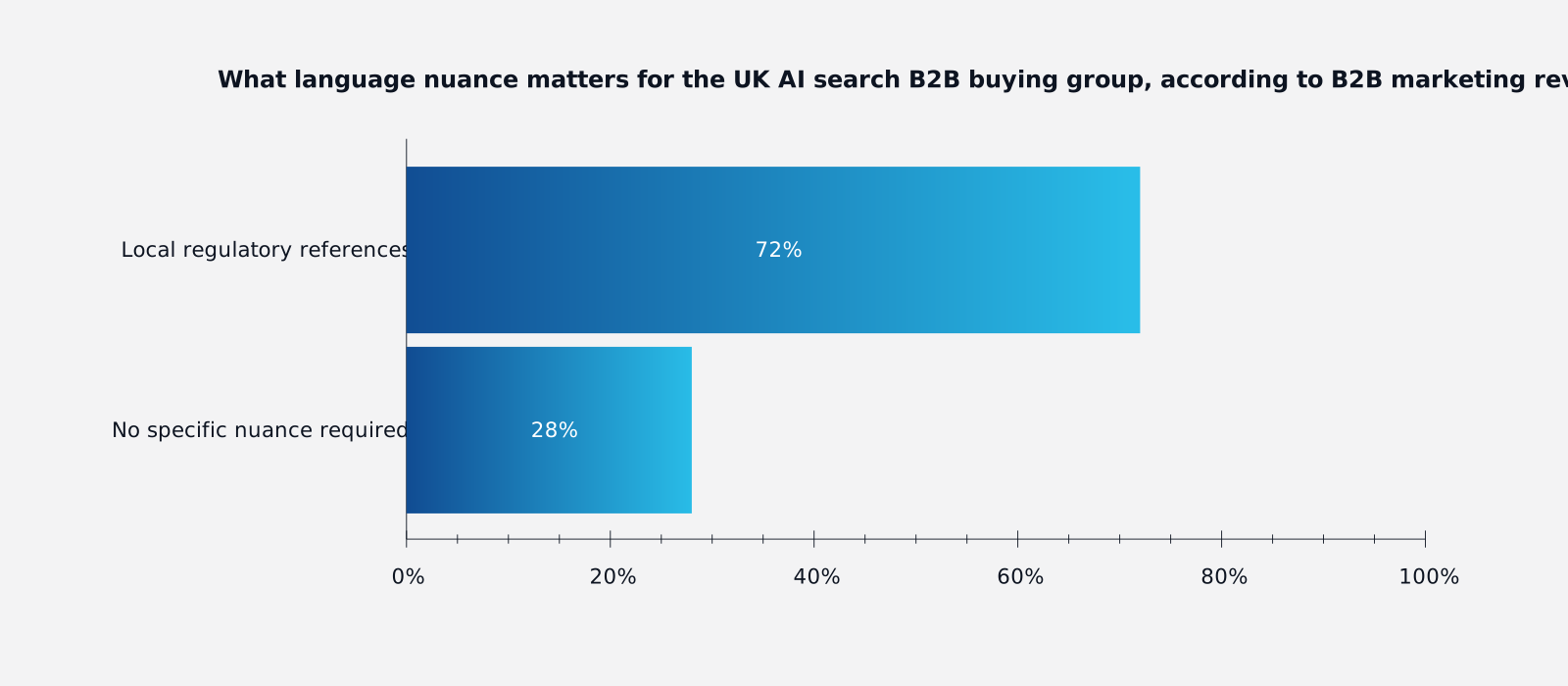
For the UK AI search B2B buying group, local regulatory references are the most important language nuance for 72% of B2B marketing revenue leaders. This points to content needing more than UK spelling or familiar terminology. Buyers are more likely to engage with information that recognises the rules affecting their sector and speaks to the regulatory environment they actually operate in. Referencing the right UK framework can also make AI-search content feel more credible and immediately useful.
The remaining 28% say no specific language nuance is required. For these leaders, broader wording may already work well because the subject is less dependent on local regulation or because the buying decision is driven by issues that translate easily across markets.
AI search’s growing role in B2B buying
This analysis of these opinions from B2B marketing revenue leaders gives us a clear sense of where AI search now sits in the buying process. It is no longer something brands can treat as a side issue. The bigger challenge is understanding how to stay visible as buyer behaviour changes, while making sure teams can respond in ways that are useful and commercially relevant.

Send to your email
Enter your email below and a link to download the PDF of this article will be sent directly to your inbox.